
International Services Week 2025 defines the new playbook for a services industry disrupted by AI

- July 29
- 6 Minute Read
For the last decade, the services economy has been the undisputed engine of business growth. We told ourselves a simple story: as long as we hired smart people and won the next project, growth was inevitable.
That story has now officially come to an end. The playbook that got us here is obsolete.
At the same time, AI is flipping the script for many services processes. Predictive AI has transformed planning and forecasting. Generative AI has changed how proposals, documentation, account summaries, and insights are produced. But it’s Agentic AI that is set to disrupt fundamentally core functions like resource management and project execution, opening the door to a new hybrid workforce of human and digital labor.
This leaves leaders facing two simultaneous existential dilemmas: How to restore profitability to a struggling operational model, while at the same time re-engineering that entire model for an era now being completely redefined by artificial intelligence?
Finding the answers is the mission of International Services Week, returning September 8-12, 2025. We’re bringing together leaders, innovators, and practitioners from across the globe to define a new playbook for orchestrating people, work, and outcomes with AI.
The Services Engine’s Efficiency Problem
Put simply, the industry has successfully built a much bigger and more powerful engine, but that engine has become less fuel-efficient.
The growth is undeniable: services revenue has overtaken product revenue, now accounting for two-thirds of the technology economy according to TSIA.
But the profitability from that growth is eroding at an alarming rate, with average EBITDA falling from 15.4% in 2023 to a five-year low of 9.8%, according to SPI Research.
This inefficiency is driven by declining operational health, as billable utilization drops to 68.9%—well below the 75% benchmark for a healthy services organization—and on-time project delivery falls to just 73.4%, down from over 80% in recent years, as SPI Research also found.
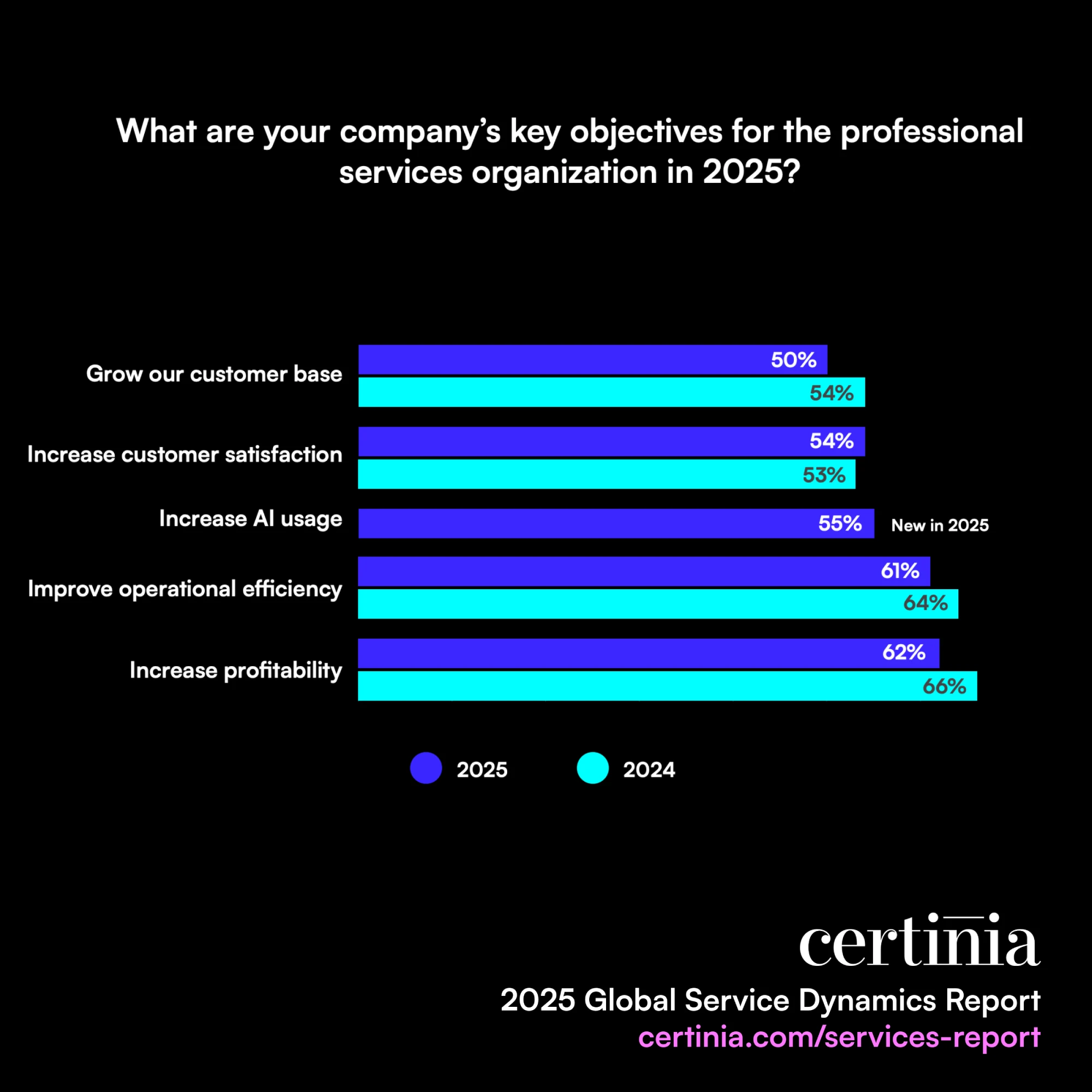
It’s no surprise, then, that our 2025 Global Service Dynamics Report revealed that increasing profitability is the number one objective for 62% of services organizations in 2025.
An Outdated Playbook from a Product-Centric Era Fuels the Friction
The growth shows that the services model is winning. But the decline in profitability proves the industry is still running on an old, product-centric playbook ill-suited for the unique DNA of service delivery.
This inefficiency most often manifests as operational friction—the result of disconnected systems and the infamous “bucket brigade” where teams pass customer data between silos.
This once quaint inefficiency has ballooned into a direct threat to retention, creating a stark execution gap: while leaders know alignment improves margins, the latest Global Service Dynamics Report found that only 36% of PS teams actually work proactively with their sales and CS counterparts.
This creates a massive visibility gap—a recent Forrester study revealed only 23% of firms have end-to-end visibility into their customer lifecycle—and it’s why 92% of senior sales executives now agree their entire engagement model needs a significant evolution, according to TSIA.
And then, into this already turbulent landscape comes the greatest catalyst for change our industry has ever seen: Artificial Intelligence.
While AI is rewriting the rules of service delivery, much of the conversation remains stuck in a primitive loop of fear and hype. The real story is more nuanced and far more powerful. It’s about strategically leveraging the three faces of AI—predictive, generative, and agentic—to build a new operating model for services.
In Practice: Orchestrating People, Work, and Outcomes with AI
Simply buying more AI is not the answer. Winning in this era requires a new discipline: intelligently and methodically applying AI to orchestrate people, work, and outcomes with certainty.
- Orchestrating People: This is the evolution of resource management, creating a blended workforce where human expertise is augmented by AI agents, ensuring the right skills—human or digital—are deployed to the right work at the right time.
- Orchestrating Work: Putting an end to the bucket brigade requires a unified data platform that provides a single source of truth across the entire services value chain: from the initial estimate to the final renewal.
- Orchestrating Outcomes: When people and work are orchestrated in harmony, we can move from being reactive to proactive, delivering the predictable outcomes our customers demand and the profitable outcomes our businesses require. The results are undeniable: Forrester Research found that high-maturity firms that get this right see 74% higher customer satisfaction and 69% higher client retention.
The New Playbook Must Be Built Together
This transformation can’t happen in a silo. The challenges of adapting to AI, re-engineering our operating models, and defining the future of service delivery are too significant for any single company to solve alone. They require a means for collaboration, debate, and shared learning. A quorum. A consensus of the majority.
That is the essence of International Services Week.
Our unique position at the intersection of services delivery, financials, and customer success gives us a panoramic view of the challenges and opportunities ahead. We see the friction caused by disconnected systems every day. We are at the forefront of building the AI-powered solutions to solve it. This perspective compels us to lead the effort in building a stronger, more resilient, and more innovative services community.
International Services Week is our commitment to that responsibility, an effort we are proud to champion alongside numerous partners, customers, and other leaders from across the services ecosystem.
While we are leading the charge, Services Week is designed to be a neutral platform that benefits every service practitioner, everywhere. For you, it’s an opportunity to:
- Get Ahead of the Curve: Learn directly from the experts who are defining the future of services. Gain practical strategies for leveraging AI, improving orchestration, and advancing your skills that you can apply immediately to your work.
- Connect with Your Peers: Join a global community of fellow practitioners to share real-world experiences, learn from others facing the same daily challenges, and build your professional network.
- Shape Your Future: Understand the signals and trends that are redefining roles and career paths across the services industry, giving you the knowledge to navigate what’s next and become an indispensable leader in your organization.
Define the Future, or Be Defined by It
This is your invitation to participate. Establish yourself as a thought leader by sharing your perspective in an article or hosting a panel on one of the week’s themes. Build your community and professional network by organizing a local event or joining the #ServicesWeek conversation online. You can also make a meaningful impact by leading your team in a volunteering or charitable initiative as part of our international day of service.
The playbook for the next era of services is unwritten, and it must be built together. This is a call to the leaders, the innovators, the movers and shakers, to step forward and orchestrate what comes next. Join us for International Services Week and be a part of building it.
Recent Articles





Maximize your Salesforce investment with Certinia